
1. Product Overview: What Is HPMC
2. Molecular Structure and Core Performance Mechanisms
3. Key Technical Parameters Explained
4. Hot-Soluble vs. Cold-Water Dispersible: Two Processing Routes
5. Seven Construction Application Scenarios and Viscosity Selection
6. HPMC vs. Other Cellulose Ethers
7. Dosage Calculation and Reference Formulations
8. Troubleshooting Common Construction Problems
9. Storage and Handling Precautions
10. Frequently Asked Questions (FAQ)
In dry-mix mortar, putty powder, tile adhesive, and other construction dry-mix materials, Hydroxypropyl Methylcellulose (HPMC) is one of the core functional additives. Whether a batch of mortar feels smooth during application, whether it powders or cracks after being applied to the wall -- these outcomes largely depend on whether the HPMC grade and dosage are properly selected.
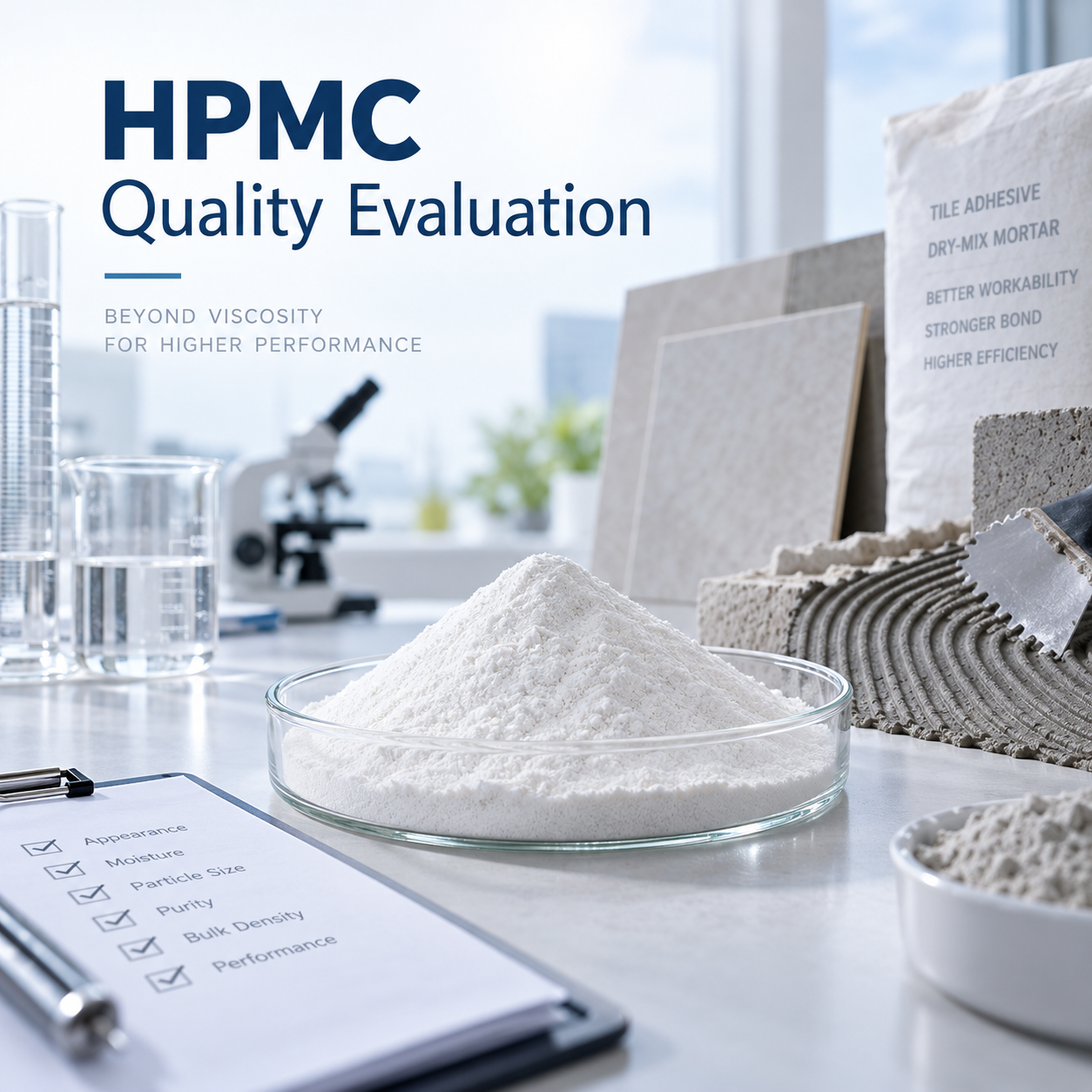
However, many construction material manufacturers fall into the trap of "looking only at viscosity, not at the application" when selecting HPMC, resulting in inconsistent mortar performance. This article starts from the water retention and thickening mechanisms of HPMC, and systematically reviews the selection parameters for different mortar types, the correspondence between viscosity grades and workability, to help technical personnel make more precise formulation decisions.
Hydroxypropyl Methylcellulose (HPMC), CAS No. 9004-65-3, is a non-ionic cellulose mixed ether. It is manufactured from natural plant fibers (refined cotton or wood pulp) through alkalinization and etherification. The appearance is a white to off-white fibrous or granular powder.
HPMC is soluble in cold water, forming a transparent or semi-transparent colloidal solution. It is insoluble in hot water, ethanol, diethyl ether, and acetone. Its aqueous solution exhibits surface activity with high clarity and stable performance. It adapts well to acidic and alkaline environments and shows good compatibility with cementitious materials such as cement, gypsum, and lime.
The molecular chain of HPMC contains two types of substituents: methoxy groups (-OCH3) and hydroxypropyl groups (-OCH2CH(OH)CH3). This unique non-ionic structure gives HPMC five core functions:
The hydroxyl and ether oxygen groups on the HPMC molecular chain can form hydrogen bonds with water molecules, effectively "locking" free water within the mortar system and slowing down water penetration into the substrate or evaporation into the air. Quality HPMC can increase the mortar water retention rate from 60% to above 90%, ensuring that the cement has sufficient moisture to complete the hydration reaction during curing, thereby improving bond strength and durability.
Once dissolved, HPMC forms a polymer network structure that significantly increases the viscosity of the mortar and improves anti-sag performance. In applications such as tile adhesive and exterior wall putty, the thickening effect enables vertical application without slumping, ensuring stability during thick-coat application.
HPMC molecules form a lubricating film on the surface of mortar particles, reducing inter-particle friction. This makes troweling and spreading smoother and less labor-intensive, reduces blade sticking, and improves the efficiency of both manual and mechanical application.
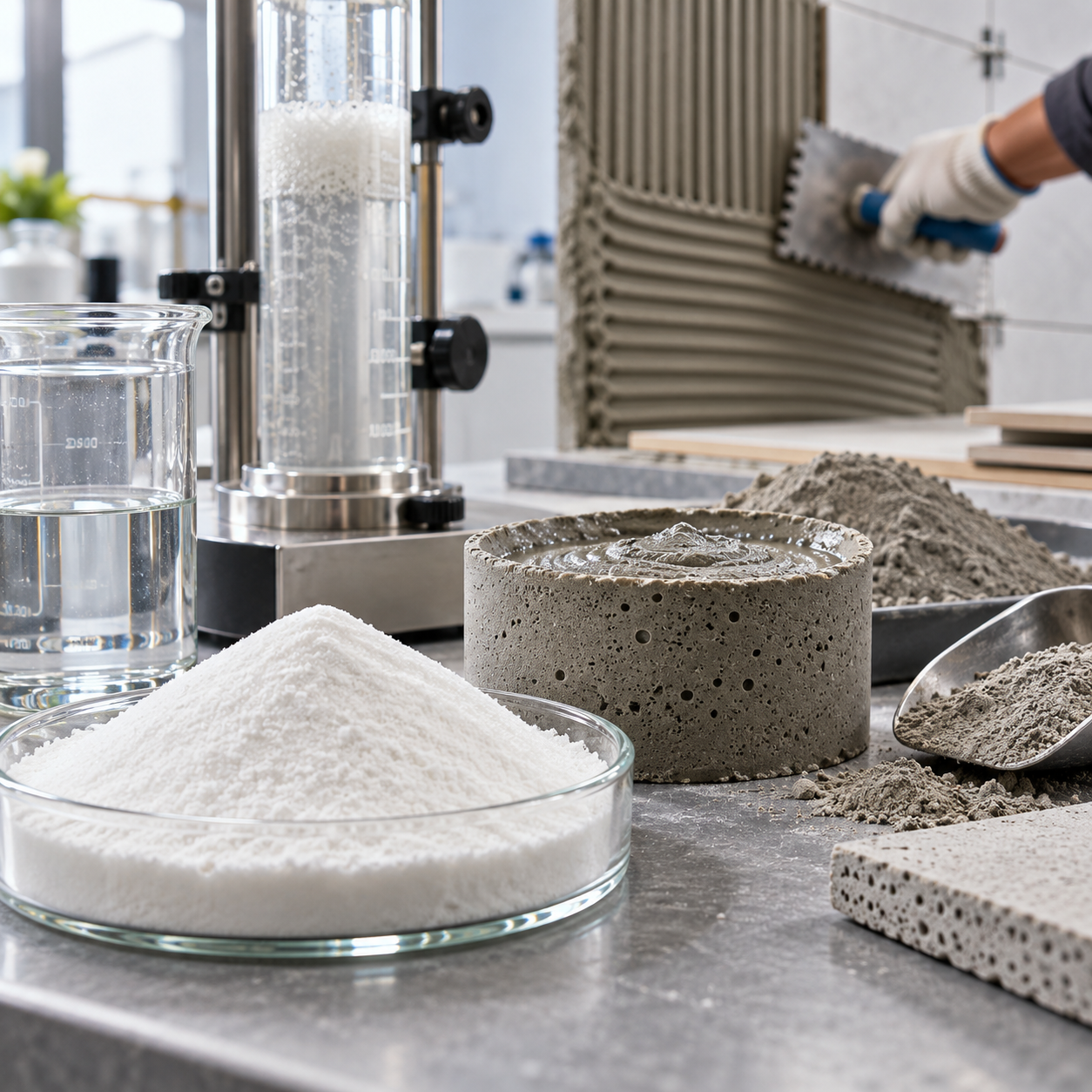
HPMC itself has a certain degree of air-entraining property, introducing uniform fine air bubbles (10-300 micrometers in diameter) into the mortar. This helps improve the workability, open time, and crack resistance of the mortar.
As a non-ionic cellulose ether, HPMC does not react with charged ions in the system. It remains stable within a pH range of 2-12 and demonstrates good compatibility with cement, gypsum, and various admixtures.
| Parameter | Typical Range | Impact on Application |
|---|---|---|
| Appearance | White to off-white powder | -- |
| Methoxy content | 19.0%-24.0% | Affects gel temperature and water retention |
| Hydroxypropoxy content | 4.0%-12.0% | Affects hydrophilicity and dissolution rate |
| Loss on drying | Below 5.0% | Storage stability and dosing accuracy |
| Viscosity (2% solution, 20 degrees C) | 400-200,000 mPa.s | Core parameter, determines thickening capacity |
| pH (2% solution) | 5.0-8.5 | Neutral to weakly alkaline, compatible with construction materials |
| Water-insoluble matter | Below 0.5% | Reflects product purity |
| Ash content | Below 1.0% | Reflects inorganic impurity content |
| Comparison Item | Hot-Soluble (Dry Powder Type) | Cold-Water Dispersible (Instant Type) |
|---|---|---|
| Behavior in cold water | Clumps, does not disperse | Disperses rapidly without clumping |
| Dissolution method | Must be pre-mixed with dry powder before adding water, or dispersed in hot water then cooled | Can be directly sprinkled into cold water |
| Application scope | Dry-mix mortar, putty powder, tile adhesive, and other dry powder systems | Liquid coatings, adhesives, daily chemical products, and other liquid systems |
| Usage share in construction | Approximately 90% or more | Relatively small |
In the construction industry, hot-soluble HPMC is used in the vast majority of cases. The method is to pre-mix HPMC with cement, sand, fillers, and other dry materials, then add water during application. It is important not to add hot-soluble HPMC directly into water, as this will form "fish-eye" clumps where the inner powder is encapsulated by a gel layer and cannot disperse.
| Application | Recommended Viscosity (mPa.s) | Dosage (% of dry powder) | Key Requirement |
|---|---|---|---|
| Masonry mortar | 15,000-40,000 | 0.1-0.2 | Water retention and bonding, ensuring dense joints |
| Rendering mortar (manual) | 75,000-100,000 | 0.2-0.3 | Anti-sag, water retention, surface finish |
| Rendering mortar (machine-sprayed) | Approximately 40,000 | 0.15-0.25 | Reduced pumping resistance, water retention |
| Putty (interior wall) | Approximately 100,000 | 0.3-0.5 | Smooth troweling, water retention, crack resistance |
| Putty (exterior flexible) | 150,000 | 0.4-0.6 | High water retention, high crack resistance |
| Tile adhesive (small format) | 15,000-30,000 | 0.2-0.35 | Anti-slip, moderate open time |
| Tile adhesive (large format 600x1200+) | 40,000-80,000 | 0.25-0.4 | Long open time, strong anti-slip |
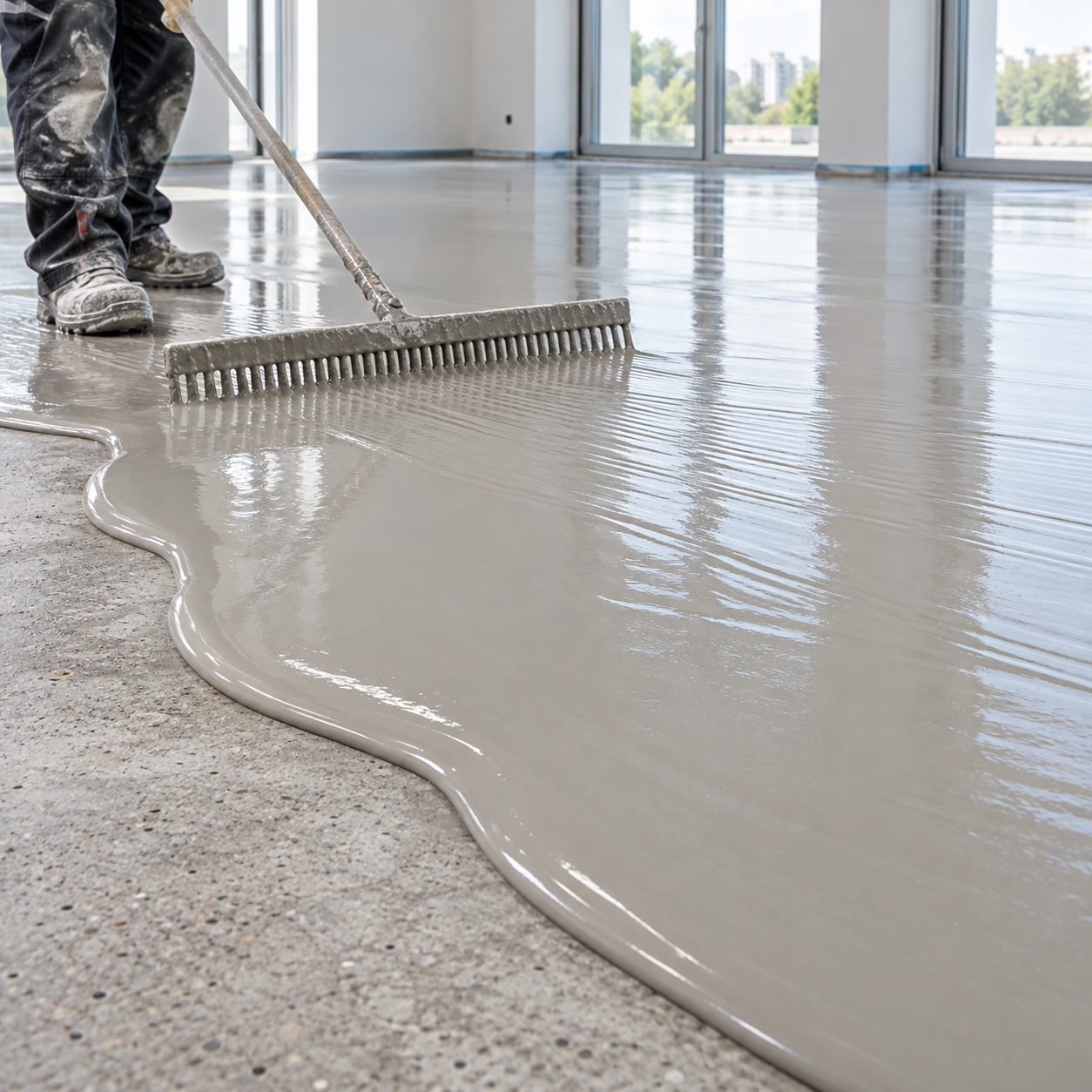
| Self-leveling mortar | 400-2,000 | 0.05-0.1 | Flowability, stable bleeding |
| EIFS (Exterior Insulation & Finish System) | 80,000-120,000 | 0.3-0.45 | Anti-sag, adhesion, flexibility |
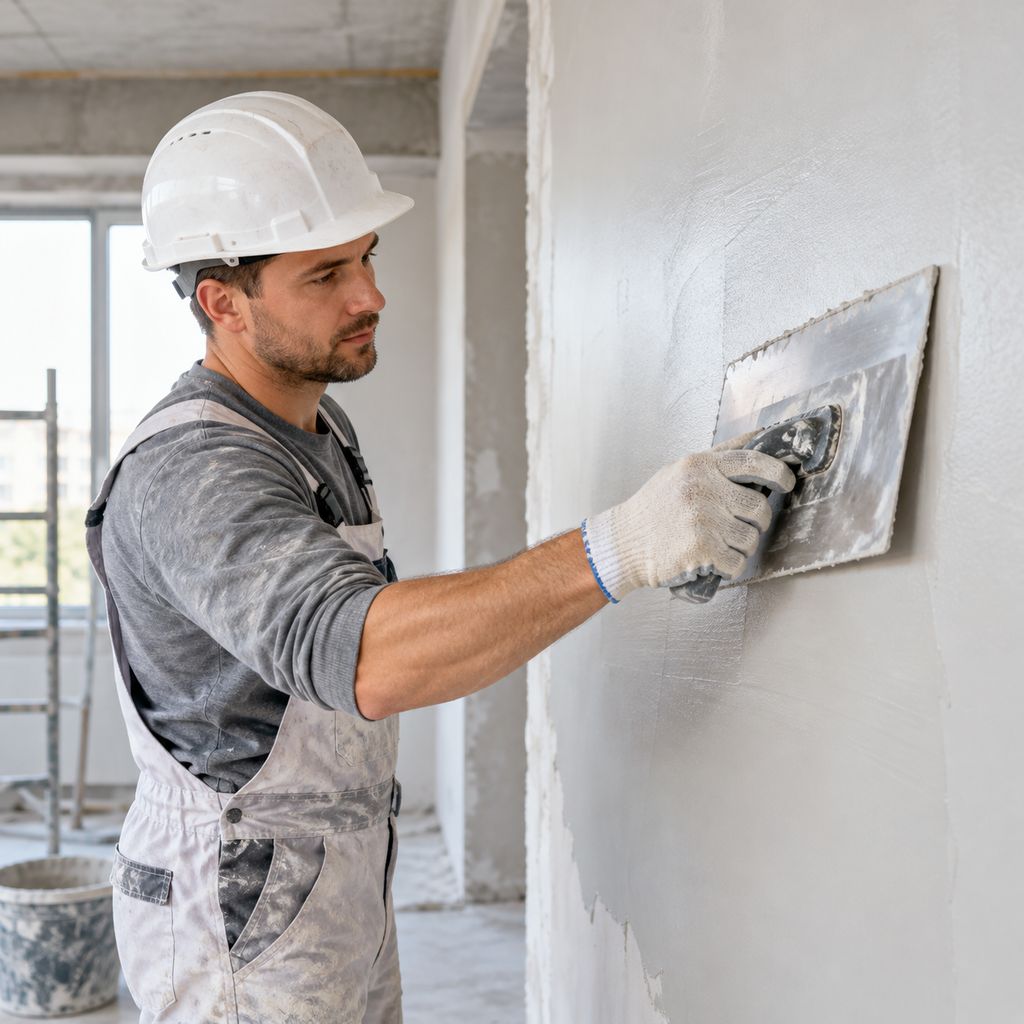
| Gypsum-based products | 400-40,000 | 0.2-0.4 | Uniform mixing, controlled consistency |
Putty powder is one of the largest consumption categories for HPMC in construction materials (accounting for approximately 60% or more of construction-grade HPMC consumption). The three main functions of HPMC in putty are: thickening, water retention, and improving workability.
Interior wall putty: Select HPMC with approximately 100,000 mPa.s viscosity, dosage 0.3%-0.5%. Provides smooth troweling without blade sticking and good water retention.
Exterior flexible putty: Select 150,000 mPa.s, dosage 0.4%-0.6%, for higher crack resistance requirements.
Tile adhesive requires excellent anti-slip properties and a sufficiently long open time. The viscosity of HPMC directly affects the open time:
Low viscosity (15,000-30,000): Open time approximately 15-35 minutes, suitable for standard small tiles.
Medium-high viscosity (40,000-80,000): Open time up to 50-68 minutes, suitable for large-format tiles.
Self-leveling mortar is the only category that requires low-viscosity HPMC. Low-viscosity HPMC does not provide thickening; instead, it stabilizes bleeding and prevents aggregate settlement. The dosage must be precisely controlled -- too much will significantly reduce flowability.
EIFS bonding mortar and rendering mortar require high-viscosity HPMC (80,000-120,000 mPa.s), used in combination with redispersible polymer powder, to provide strong adhesion, flexibility, and anti-sag performance.
| Parameter | HPMC | HEMC | MC (Methylcellulose) | CMC (Sodium Carboxymethyl Cellulose) |
|---|---|---|---|---|
| Ion type | Non-ionic | Non-ionic | Non-ionic | Anionic |
| Water retention | Excellent | Excellent | Good | Moderate |
| Gel temperature | 58-75 degrees C | Approximately 190-200 degrees C | Approximately 40-50 degrees C | Not applicable |
| Alkali resistance | Excellent | Excellent | Good | Poor (precipitates with calcium ions) |
| Mold resistance | Moderate | Better than HPMC | Moderate | Poor |
| Construction applicability | Broad, good cost-performance ratio | Preferred for high-temperature environments | Being gradually replaced | Not suitable for cement systems |
| Price | Moderate | Higher than HPMC | Lower | Lower |
Selection advice: Under normal temperature conditions, HPMC offers a favorable cost-performance ratio. For summer high-temperature construction (when the ambient temperature frequently exceeds the HPMC gel temperature), HEMC or high gel temperature HPMC grades can be considered. CMC, due to its poor alkali resistance, is not suitable for cement-based mortar systems.
HPMC dosage is calculated as a mass percentage of the total dry powder weight. Insufficient dosage leads to inadequate water retention, causing mortar cracking and powdering; excessive dosage causes stickiness, increased water demand, and excessive air entrainment leading to reduced strength. Laboratory small-scale testing is required to determine the appropriate dosage.
| Raw Material | Dosage (kg/ton) | Function |
|---|---|---|
| Heavy calcium carbonate (325 mesh) | 750-800 | Filler |
| Hydrated lime (calcium hydroxide) | 200-250 | Cementitious material |
| HPMC (100,000 viscosity) | 3-5 | Water retention and thickening |
| Raw Material | Dosage (%) | Function |
|---|---|---|
| Portland cement 42.5 | 25-30 | Cementitious material |
| Quartz sand (0.1-0.5mm) | 65-70 | Aggregate |
| HPMC (40,000-60,000 viscosity) | 0.20-0.30 | Water retention, anti-slip |
| Calcium formate (accelerator) | 0.5 | Promotes early strength |
| Raw Material | Dosage (%) | Function |
|---|---|---|
| Portland cement | 25-30 | Cementitious material |
| Quartz sand and fillers | 55-60 | Aggregate |
| HPMC (80,000-120,000 viscosity) | 0.30-0.45 | Water retention, anti-sag |
| Redispersible polymer powder | 5-8 | Flexible bonding |
| Wood fiber | 0.2-0.4 | Crack resistance reinforcement |
| Problem | Possible Cause | Solution |
|---|---|---|
| Cracking after application | Insufficient water retention, moisture evaporates too quickly | Increase HPMC dosage by 0.05%-0.1%; or switch to a higher viscosity grade |
| Trowel sticking during application | HPMC dosage too high or viscosity too high | Reduce dosage; or switch to a lower viscosity grade |
| "Fish-eye" clumps in mortar | HPMC not properly dispersed, clumps on contact with water | Ensure uniform dry pre-mixing; let stand 3-5 minutes after adding water before mixing |
| Tiles sliding down after installation | Insufficient open time or poor anti-slip properties | Increase HPMC viscosity grade (40,000-80,000) or increase dosage |
| Poor workability in summer, dries too fast | Temperature exceeds HPMC gel temperature, water retention drops sharply | Switch to a high gel temperature grade or use HEMC |
| Slow dissolution and sluggish workability in winter | HPMC viscosity too high at low temperatures | Switch to a slightly lower viscosity grade for winter; increase mixing water temperature (not exceeding 40 degrees C) |
| Excessive foaming in mortar | HPMC air-entrainment too strong or over-mixing | Reduce dosage; control mixing time and speed |
| Setting time too long | HPMC dosage too high | Reduce dosage, or add a small amount of accelerator (e.g., calcium formate) |
Storage conditions: Store in a dry environment at 5-30 degrees C, humidity below 65% RH, keep original packaging sealed.
Shelf life: Generally 24 months under proper storage conditions.
Moisture protection: HPMC is hygroscopic and tends to clump. Use promptly after opening; reseal the bag tightly if not fully used.
Water quality impact: Very hard water (calcium/magnesium ion concentration exceeding 500 ppm) may slightly affect dissolution speed and transparency, but does not affect core functions. Avoid using water with high iron ion content (which may cause yellowing of the solution).
Mixing sequence: In dry-mix mortar, HPMC should be thoroughly mixed with other powders before adding water. Do not add HPMC dry powder to water first.
HPMC provides five core functions in mortar: water retention (locking moisture to ensure complete cement hydration, with water retention rates above 90%), thickening and anti-sag (forming a polymer network to increase viscosity), improved workability (lubricating mortar particles to reduce troweling resistance), air entrainment (introducing uniform micro-bubbles to improve workability), and chemical stability (non-ionic type, compatible with cement and gypsum).
For interior wall putty, the recommended HPMC dosage is 0.3%-0.5% of total dry powder weight, with a recommended viscosity of approximately 100,000 mPa.s. For exterior flexible putty, the suggested dosage is 0.4%-0.6% with a viscosity of 150,000 mPa.s for higher crack resistance. Exact dosage should be determined through laboratory testing based on climate conditions, lime quality, and construction requirements.
Both HPMC (Hydroxypropyl Methylcellulose) and HEMC (Hydroxyethyl Methylcellulose) are non-ionic cellulose ethers. However, HEMC has a higher gel temperature (approximately 190-200 degrees C), providing more stable water retention during hot summer construction. HEMC also has better mold resistance than HPMC but is more expensive. HPMC offers a favorable cost-performance ratio and is one of the widely used cellulose ether varieties in the construction materials industry.
Excessive HPMC causes: mortar becoming too sticky and adhering to the trowel, reducing work efficiency; increased water demand leading to strength reduction; excessive air entrainment reducing hardened mortar density and compressive strength; significantly prolonged setting time affecting schedule; and unnecessary cost increases. It is recommended to strictly follow the recommended dosage and determine the appropriate dosage through small-scale testing.
HPMC water retention drops sharply when approaching its gel temperature. Solutions: (1) Switch to a high gel temperature grade (above 75 degrees C) or use HEMC; (2) Increase the dosage by 0.05%-0.1%; (3) Pre-wet the substrate surface before application to reduce moisture absorption; (4) Avoid working during the hottest midday hours.
No. Viscosity should match the formulation requirements: self-leveling mortar needs low viscosity (400-2,000 mPa.s) to ensure flowability; putty and tile adhesive need medium-to-high viscosity (15,000-150,000 mPa.s) for water retention and anti-sag. Higher viscosity does not mean better overall performance -- excessive viscosity causes stickiness, difficult application, and excessive air entrainment. The core selection principle is "matching the application requirements."
Professional Supplier of HPMC Hydroxypropyl Methylcellulose
Full Viscosity Range | Stable Water Retention | Consistent Batch Quality
Main Products: HPMC | Hydroxypropyl Methylcellulose
 HPMC in Self-Leveling Mortar: Evaluating Flow, Stability and Surface Quality
 HPMC in Gypsum Plaster: How It Affects Workability, Water Retention and Surface Finish
 Why Does HPMC-Modified Mortar Contain Too Much Air? Causes, Testing and Formulation Troubleshooting
 How to Evaluate HPMC Quality Beyond Viscosity? Key Parameters for Construction Grade HPMC Selection

