
HPMC (Hydroxypropyl Methylcellulose) is widely used in construction formulations such as tile adhesives, cement mortars, wall putty and gypsum-based products.
When selecting HPMC, one of the first specifications buyers see is viscosity.
Common commercial grades may include values such as:
40,000 mPa·s
50,000 mPa·s
100,000 mPa·s
150,000 mPa·s
200,000 mPa·s
This often leads to a simple question:
Which viscosity is best for construction?
The answer depends on the application.
A higher viscosity grade is not automatically a better grade. What matters is whether the HPMC provides the required water retention, rheology, consistency and workability in the actual formulation.
HPMC viscosity refers to the resistance to flow of an HPMC aqueous solution measured under specified conditions.
The result depends on several factors, including:
solution concentration;
temperature;
viscometer type;
spindle;
rotational speed;
sample preparation method.
For this reason, two products both labeled 100,000 mPa·s should not automatically be considered identical unless they were tested under comparable conditions.
This is an important point when comparing HPMC from different sources.
In a mortar system, HPMC affects the aqueous phase and therefore influences fresh-state rheology.
Depending on the formulation, viscosity can affect:
mortar consistency;
troweling behavior;
sag resistance;
spreading;
wet stability;
application feel.
However, construction mortar needs balance.
If the system is too thin, it may lack stability.
If it is too thick, application may become difficult.
Therefore, the correct target is not maximum viscosity, but appropriate rheology for the intended application.
No.
This is one of the most common misunderstandings in HPMC selection.
A higher-viscosity HPMC can provide stronger thickening under defined conditions, but excessive viscosity may lead to:
higher troweling resistance;
reduced spreadability;
increased mixing resistance;
different water demand;
a heavier application feel.
Therefore:
Higher viscosity is not equal to higher quality.
Viscosity is a product characteristic, not a quality ranking.
The difference is mainly the viscosity level measured under specified test conditions.
A 200,000 mPa·s grade generally provides stronger thickening than a 100,000 mPa·s grade under comparable measurement conditions.
But that does not mean the 200,000 grade will always perform better in mortar.
The actual result depends on:
HPMC dosage;
cement content;
filler composition;
aggregate grading;
water dosage;
RDP content;
starch ether or other rheology modifiers;
application method.
A 100,000 mPa·s HPMC may be suitable for one formulation, while a higher-viscosity grade may be more appropriate for another.
There is no single viscosity value suitable for all tile adhesives.
Tile adhesive formulations vary in:
cement content;
filler grading;
polymer powder dosage;
water demand;
tile type;
installation thickness;
sag requirements;
open time requirements.
For this reason, medium-to-high viscosity construction grades are commonly evaluated, but the final choice should be based on application testing.
In many formulations, around 100,000 mPa·s is a common reference range for evaluation, but it should not be treated as a universal rule.
HPMC performs several functions in tile adhesive.
It helps reduce rapid water loss after the adhesive is applied.
It contributes to the consistency of the fresh mortar.
It can influence how easily the adhesive spreads under a notched trowel.
It helps the formulation maintain sufficient structure in vertical applications.
By influencing water retention and fresh-mortar behavior, HPMC can affect the usable period after the adhesive is spread.
However, all of these properties depend on the complete formulation.
This distinction is important.
Viscosity describes the flow resistance of an HPMC solution under specified conditions.
Water retention describes the ability of the mortar system to retain water after application.
The two properties are related, but they are not identical.
Two HPMC grades with similar viscosity can show different water-retention behavior in the same mortar.
Water retention is also affected by:
HPMC dosage;
product modification;
particle size;
cement type;
substrate absorption;
temperature;
water content.
Therefore, selecting HPMC only by viscosity may overlook an important part of application performance.
Not necessarily.
It is tempting to assume that:
higher viscosity = higher water retention.
But this relationship is not universal.
Water retention depends on the interaction between HPMC and the entire mortar system.
A higher-viscosity grade may show stronger thickening, but a different grade with similar or lower viscosity may still provide suitable water retention depending on formulation characteristics.
This is why application testing is more meaningful than relying on viscosity alone.
The term dry mix mortar covers many different construction products.
These can include:
tile adhesive;
masonry mortar;
plastering mortar;
rendering mortar;
repair mortar;
wall putty;
skim coat;
gypsum-based mixes.
Each product has different rheological and water-retention requirements.
Therefore, there is no single "dry mix mortar HPMC" viscosity suitable for every formulation.
In cement-based mortar, HPMC may influence:
water retention;
consistency;
workability;
application behavior.
The result also depends on the cement itself.
Different cement sources may vary in:
fineness;
clinker composition;
sulfate balance;
supplementary materials.
Therefore, the same HPMC grade can behave differently after the cement source changes.
Wall putty formulations differ significantly between markets.
Some are cement-based, while others use different binder systems.
HPMC may be used to control:
consistency;
water retention;
application smoothness;
wet-state behavior.
Because the binder system varies, selecting HPMC simply based on the product name “wall putty” is not sufficient.
The actual formulation needs to be considered.
Gypsum and cement are different binder systems.
Their hydration and setting behavior are not the same.
In gypsum plaster or gypsum-based formulations, HPMC can be used to influence:
water retention;
consistency;
workability;
wet stability.
However, an HPMC grade that performs well in cement mortar should not automatically be assumed to perform the same way in gypsum.
There is no universal dosage suitable for every tile adhesive.
The appropriate dosage depends on:
HPMC grade;
viscosity;
water-retention characteristics;
cement content;
filler composition;
RDP dosage;
water demand;
required open time;
required anti-sag performance.
A practical formulation approach is to test several dosage levels while keeping the other major components constant.
No.
Increasing HPMC dosage can further influence:
viscosity;
water retention;
consistency;
air content;
application behavior.
However, excessive dosage can make a formulation too thick or change its handling characteristics beyond the target range.
It can also increase formulation cost.
Therefore, the objective should be to determine the amount required for the desired performance, rather than simply increasing dosage.
Nominal viscosity is only one property.
Two HPMC grades with similar viscosity can differ in:
substitution characteristics;
degree of modification;
particle size;
surface treatment;
dissolution behavior;
gel temperature;
water-retention performance;
batch consistency.
This explains why two 100,000 mPa·s grades may not feel identical in a mortar formulation.
Construction-grade HPMC may be modified to adjust certain application characteristics.
Modification can influence aspects such as:
rheology;
sag resistance;
application feel;
water demand;
wet mortar stability.
However, the term modified HPMC can refer to different technologies depending on the product.
Therefore, it is useful to evaluate the actual application result rather than assuming that all modified grades behave the same way.
HPMC and RDP are often used together in tile adhesive and other dry-mix mortars, but they perform different functions.
| Item | HPMC | RDP |
|---|---|---|
| Material Type | Cellulose ether | Polymer powder |
| Main Function Direction | Water retention, thickening, rheology | Polymer modification, adhesion, flexibility |
| Direct Substitute? | No | No |
HPMC mainly influences fresh mortar behavior.
RDP mainly contributes polymer-related effects in the modified mortar system.
Therefore, increasing one does not directly replace the other.
Starch ether is another additive used in some dry-mix formulations.
It can influence rheology, sag behavior and application characteristics.
HPMC and starch ether should not be treated as the same material.
Depending on the formulation, they may be used together to achieve a particular rheological profile.
The dosage of both should be determined experimentally.
Temperature can influence both HPMC behavior and the overall mortar system.
At higher application temperatures:
water can evaporate more quickly;
substrate absorption may become more critical;
workable time may change;
water-retention demands can increase.
HPMC aqueous solutions also show thermal gelation behavior.
For formulations intended for hot climates, testing under representative temperatures can provide more meaningful information.
HPMC aqueous solutions can undergo changes in hydration and polymer interaction as temperature increases.
At a certain temperature range, thermal gelation can occur.
The gel temperature depends on:
substitution characteristics;
HPMC grade;
solution conditions.
This parameter may be relevant when comparing HPMC grades for construction applications, particularly where temperature conditions are important.
HPMC particles hydrate when they contact water.
If powder is added directly into water without sufficient dispersion, the surface of the particles can hydrate first and form a layer around dry material inside.
This can produce lumps.
In dry-mix mortar production, HPMC is generally blended with the other dry powders before water is added.
This helps distribute the cellulose ether throughout the formulation.
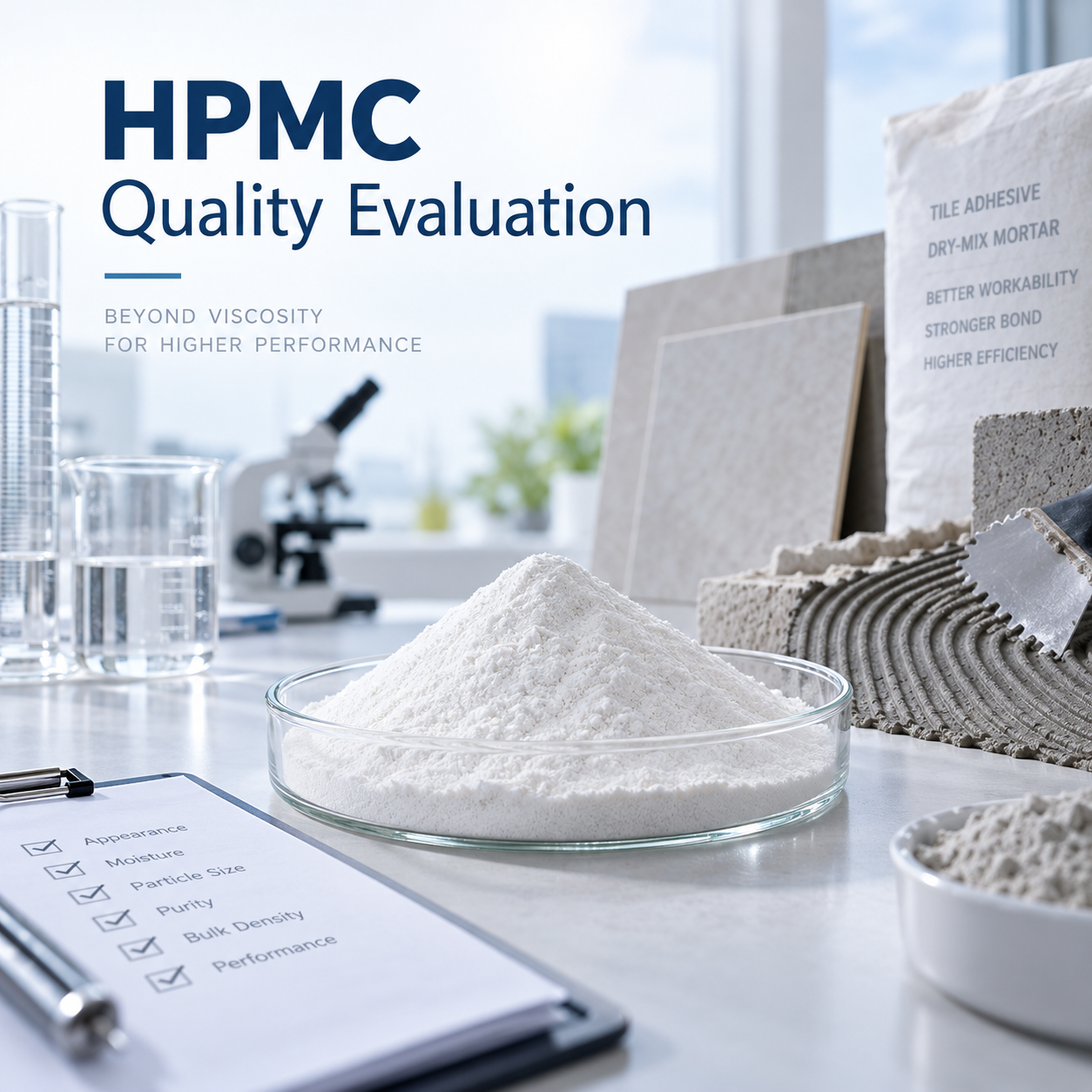
Depending on the application, buyers may review:
viscosity;
moisture;
ash content;
pH;
particle size;
substitution characteristics;
gel temperature;
appearance.
However, product specifications alone cannot fully predict mortar performance.
For construction applications, application testing is equally important.
Not necessarily.
Ash content is a useful quality-control parameter, but it does not directly determine all mortar properties.
A lower ash value does not automatically guarantee:
higher water retention;
longer open time;
better sag resistance;
better workability.
These properties need to be evaluated in the actual mortar formulation.
Suppose you want to compare HPMC-A and HPMC-B.
Use the same:
cement;
fillers;
sand;
RDP;
water dosage;
HPMC dosage;
mixing procedure;
test temperature.
Then compare:
wet consistency;
water retention;
troweling behavior;
sag resistance;
open time;
other application-specific properties.
This helps isolate the effect of the HPMC grade.
Possible causes include:
HPMC viscosity is too high;
HPMC dosage is too high;
water dosage is too low;
starch ether dosage is high;
filler grading has changed.
The full formulation should be reviewed before assuming the HPMC itself is the only cause.
Possible factors include:
insufficient rheological structure;
excessive water;
inappropriate HPMC grade;
insufficient HPMC dosage;
filler grading;
other rheology modifiers.
The formulation should be adjusted systematically.
Possible reasons include:
highly absorbent substrate;
high temperature;
low humidity;
insufficient water retention;
low HPMC dosage;
formulation imbalance.
Again, viscosity alone should not be used as the only diagnostic parameter.
A practical selection process can follow this sequence.
Is the product intended for:
tile adhesive;
mortar;
wall putty;
gypsum;
another construction formulation?
Determine whether the key requirement is:
water retention;
consistency;
sag resistance;
workability;
open time.
Choose several suitable ranges instead of automatically selecting the highest viscosity.
Compare viscosity values measured under equivalent conditions.
Use the same base formulation.
Test several HPMC dosage levels.
Consider temperature, substrate and application method.
Choose based on the performance of the finished mortar.
There is no universal value. Medium-to-high viscosity grades are commonly evaluated, but the final choice depends on the complete formulation.
It can be evaluated in many construction formulations, but suitability depends on water retention, dosage, cement, filler and application requirements.
Not necessarily. Higher viscosity provides stronger thickening but may not produce the desired workability in every formulation.
Not always. Water retention depends on more than viscosity alone.
There is no single dosage suitable for every formulation. The dosage should be established through application testing.
No. They perform different functions in dry-mix mortar.
Yes. Differences in substitution, modification, particle size and other properties can influence application behavior.
Selecting HPMC (Hydroxypropyl Methylcellulose) for tile adhesive and dry-mix mortar should not be based on viscosity alone.
Viscosity is important, but application performance also depends on:
water retention + HPMC dosage + formulation composition + cement or gypsum + fillers + RDP + temperature + application method.
Therefore, the question:
“Is 200,000 mPa·s HPMC better than 100,000 mPa·s?”
does not have a universal answer.
A more useful question is:
“Which HPMC viscosity and dosage provide the required water retention, rheology and workability in this specific formulation?”
A practical selection process is:
define the application → choose candidate viscosity grades → compare under the same test method → conduct formulation trials → optimize dosage → verify the finished mortar.
This approach provides a more meaningful basis for HPMC selection than choosing the highest viscosity value.
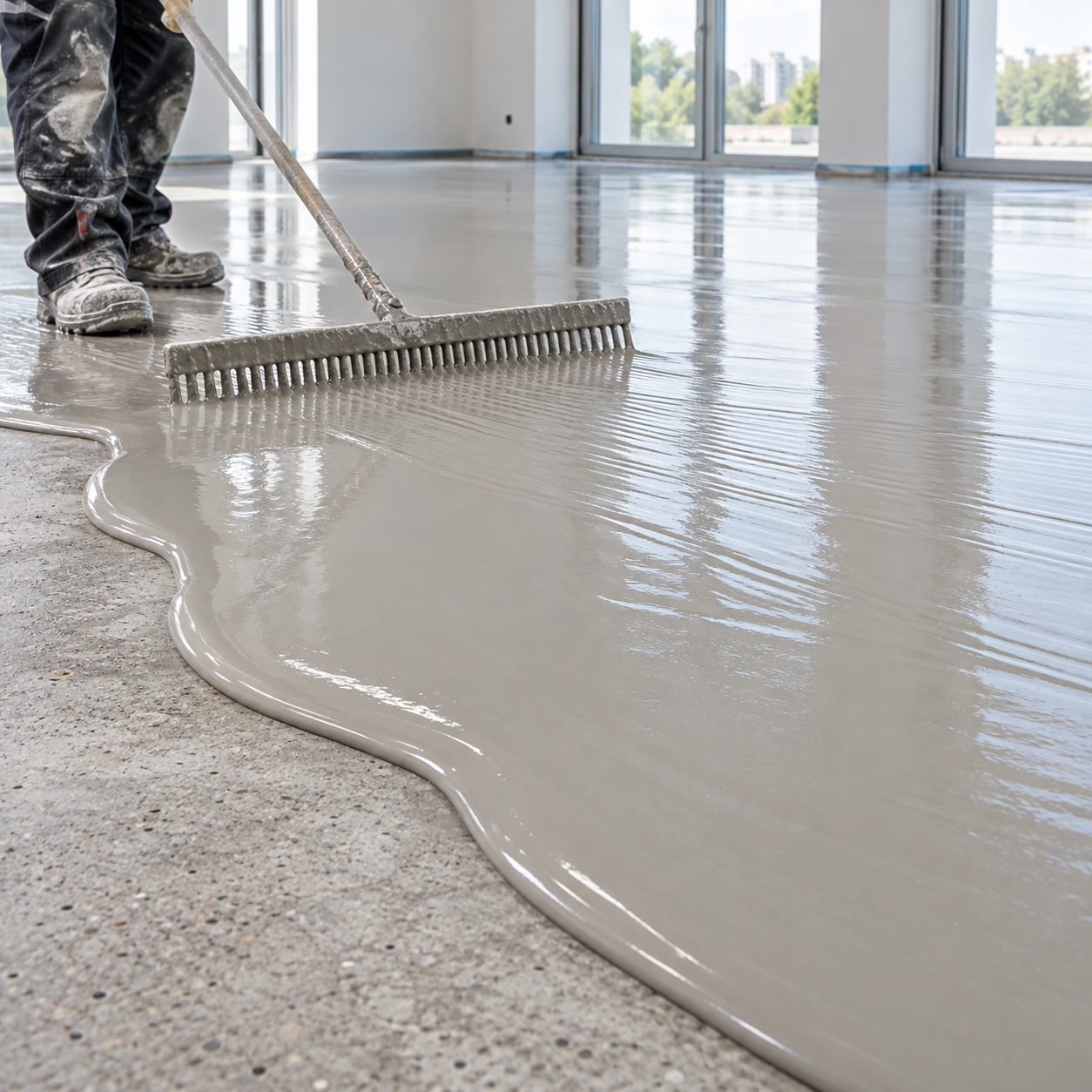 HPMC in Self-Leveling Mortar: Evaluating Flow, Stability and Surface Quality
 HPMC in Gypsum Plaster: How It Affects Workability, Water Retention and Surface Finish
 Why Does HPMC-Modified Mortar Contain Too Much Air? Causes, Testing and Formulation Troubleshooting
 How to Evaluate HPMC Quality Beyond Viscosity? Key Parameters for Construction Grade HPMC Selection

